An ancient shrine tucked into a wooded corner of a residential district, listed in the 10th-century Engishiki, with a prefecturally protected sanctuary and a drum-float autumn festival.
AI-generated motion added to photos from 2008 and 2013
Izanagi Shrine is a Shinto shrine in Yamada-higashi, Suita, Osaka, about 1.5 km south-west of the Tower of the Sun. Listed in the Engishiki of 927, its late-17th-century main sanctuary is an Osaka Prefectural Cultural Property. It is known for the taiko mikoshi autumn festival in October. Take a Hankyu Bus from Yamada Station to Yamada Miya-no-mae; entry is free.
Main sanctuary: Osaka Prefectural Tangible Cultural Property (2011)
Getting there
Bus from Yamada (Hankyu / Monorail) to “Yamada Miya-no-mae”
Visiting
Grounds open freely. Phone desk 9:00–16:30
01 — HIGHLIGHTS
What to see
01
Worship hall and main sanctuary
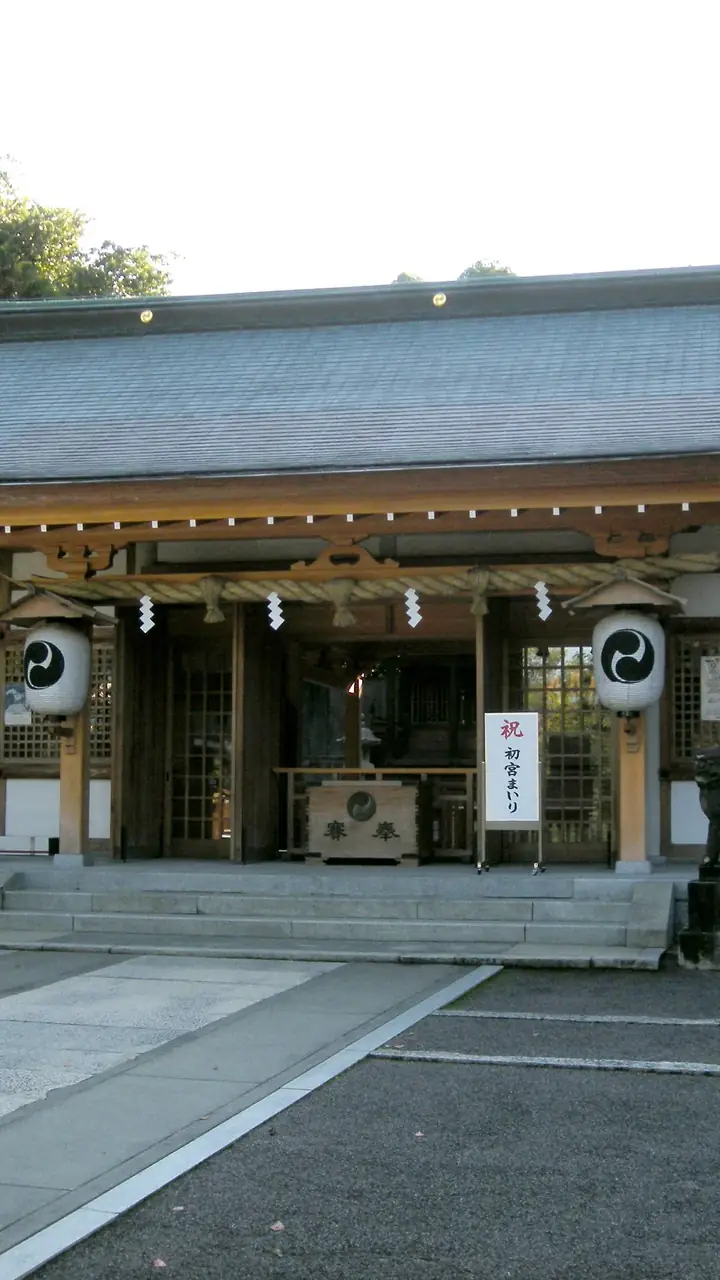
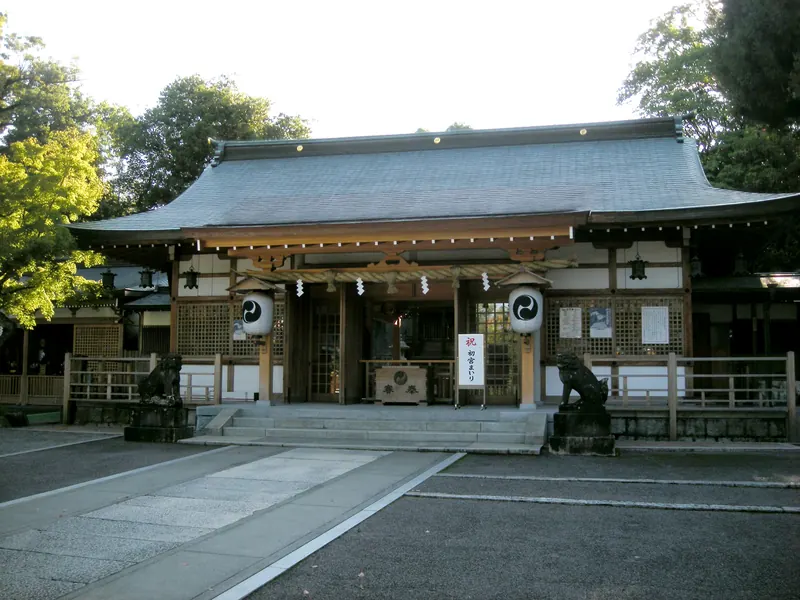
The haiden (worship hall) stands at the end of the approach, with the honden (main sanctuary) behind it. The honden is a five-bay nagare-zukuri building thought, from its style, to date from the late 17th century, noted for its wood carving. It was designated an Osaka Prefectural Tangible Cultural Property in 2011. Visitors pray from the haiden.
02
“Izanagi” shrine, “Izanami” deity
The principal deity is Izanami-no-Mikoto, the female creator deity of Japanese myth — not Izanagi, despite the shrine’s name. Locals have also called it Hime-miya (“princess shrine”) and Gosha-miya (“five-deity shrine”); four further deities share the sanctuary.
03
Small sub-shrines
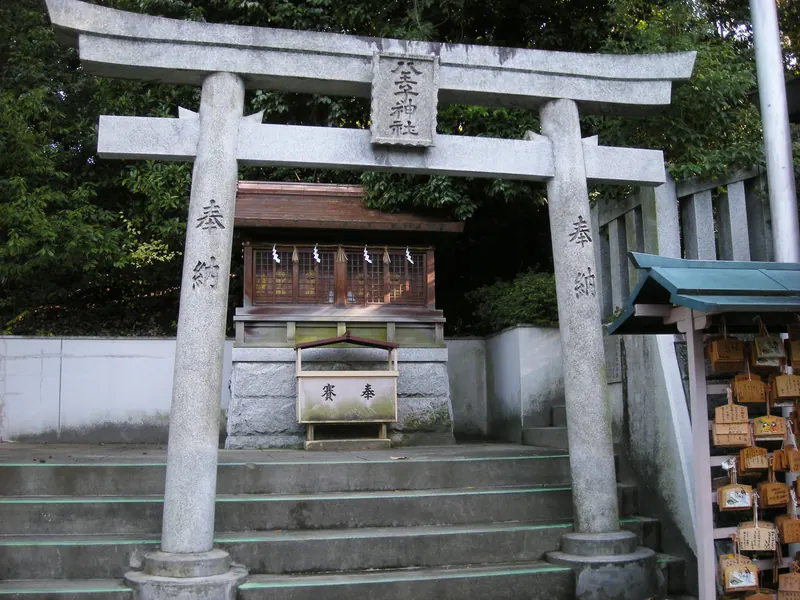
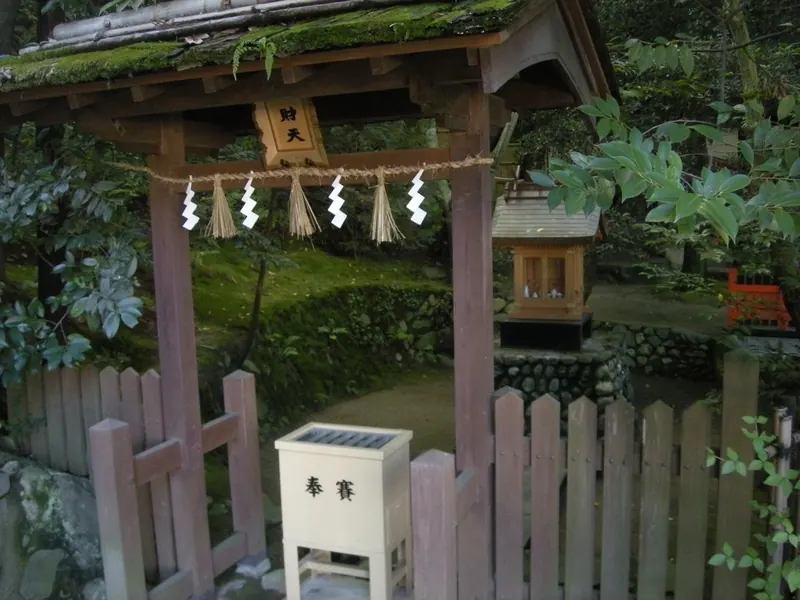
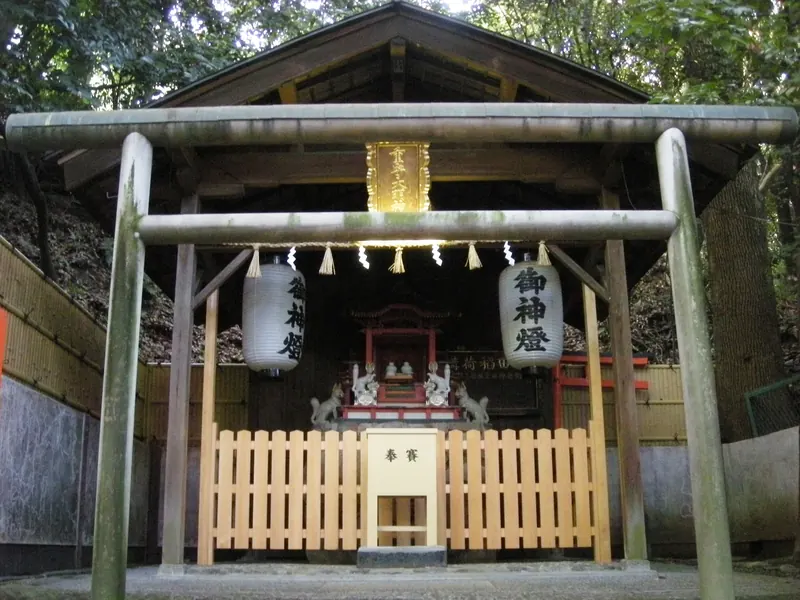
Scattered around the grounds are an Inari shrine with red torii, a Benzaiten shrine, and shrines to Tenjin, Hachioji and Hachiman. Wandering between them is part of the visit.
04
Autumn colours
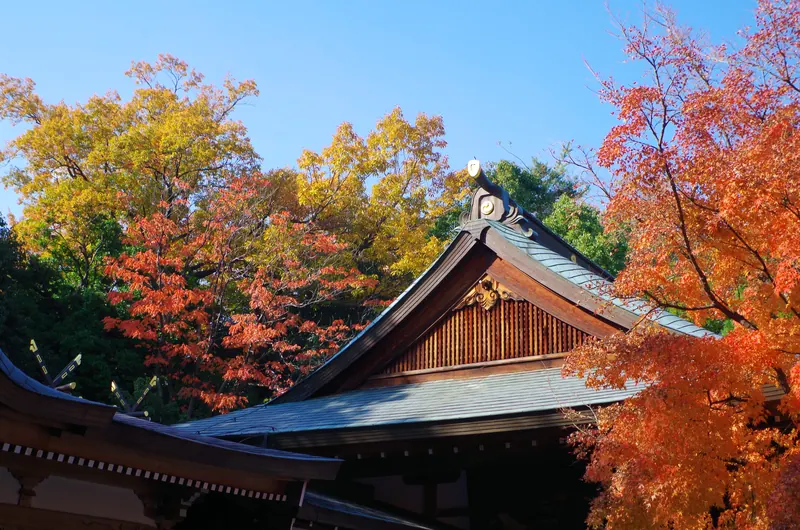
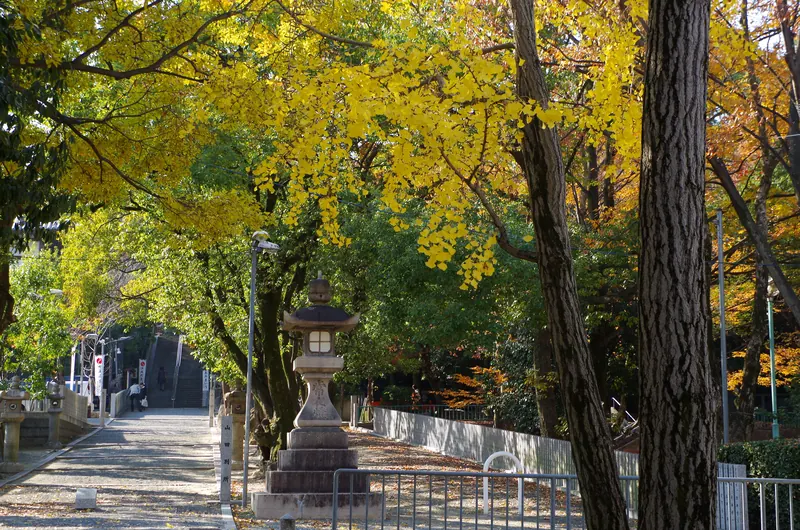
From late November to early December, maples over the shrine roofs and ginkgo trees along the approach turn red and gold — the same weeks as the Japanese Garden in Expo ’70 Park, so the two combine well.
05
Unusual guardian lions
According to the shrine, the komainu at the entrance were made in the style of roof ornaments from Jinzhou Castle in Dalian, China. Compare them with the usual Japanese style.
06
Stone name marker
The stone pillar at the entrance was erected in the Edo period as part of an effort to identify ancient shrines. Together with the marker at the Saidera shrine, it is a Suita City Tangible Cultural Property (2009).
02 — HISTORY
History: legend and record, kept apart
The shrine’s past is told through both traditions and documents. We keep the two separate.
Foundation tradition Tradition
The shrine’s own account links its origin to Emperor Yūryaku and to Ise. This is a tradition, not contemporary evidence of a founding date.
Relocation tradition Tradition
A gazetteer records a tradition that the shrine moved from Ogawadani to Takaniwayama, near the present site. Not an established date.
Nihon Sandai Jitsuroku Record
The court chronicle records a promotion in rank for the deity Izanagi — evidence that the shrine was part of the ancient state system of worship.
Engishiki register Record
The Engishiki lists “Izanagi Shrine, two seats” in Shimashimo District, Settsu Province. This does not mean today’s buildings date from then.
Main sanctuary built Estimate
The present honden is dated to about this time on the evidence of its architectural style.
Stone name markers Record
Stone markers were erected at both the Yamada and Saidera shrines during Edo-period efforts to locate ancient shrines.
Heritage designations Record
The stone markers became Suita City Cultural Properties (Feb 2009); the honden became an Osaka Prefectural Cultural Property (Jan 2011).
Torii rebuilt Record
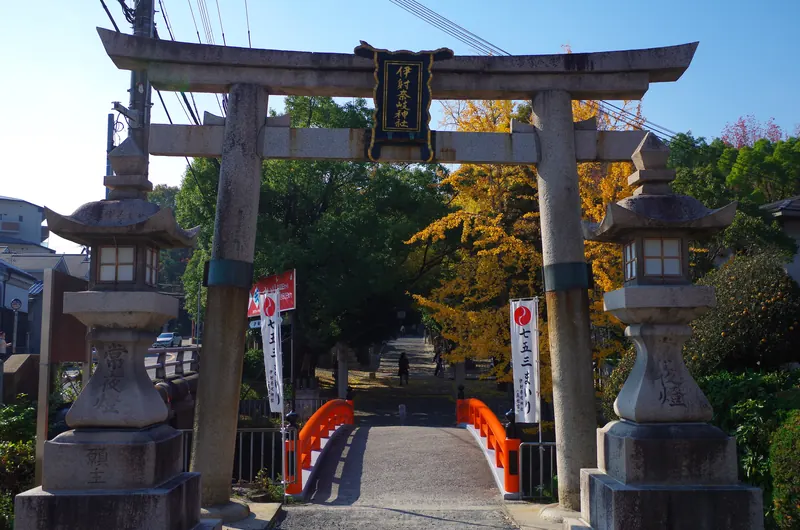
The entrance torii was damaged in the 2018 northern Osaka earthquake and replaced in 2019, so older photos do not show today’s gate.
Two Izanagi Shrines in Suita
Suita has a second Izanagi Shrine in the Saidera district. The Yamada-higashi shrine enshrines Izanami; the Saidera shrine enshrines Izanagi and is also called Oku-miya (“inner shrine”). The two are discussed in connection with the Engishiki’s “two seats”, though matching those ancient seats to today’s two precincts calls for caution. They are about 1.7 km apart as the crow flies.
03 — FESTIVALS
Festivals and annual events
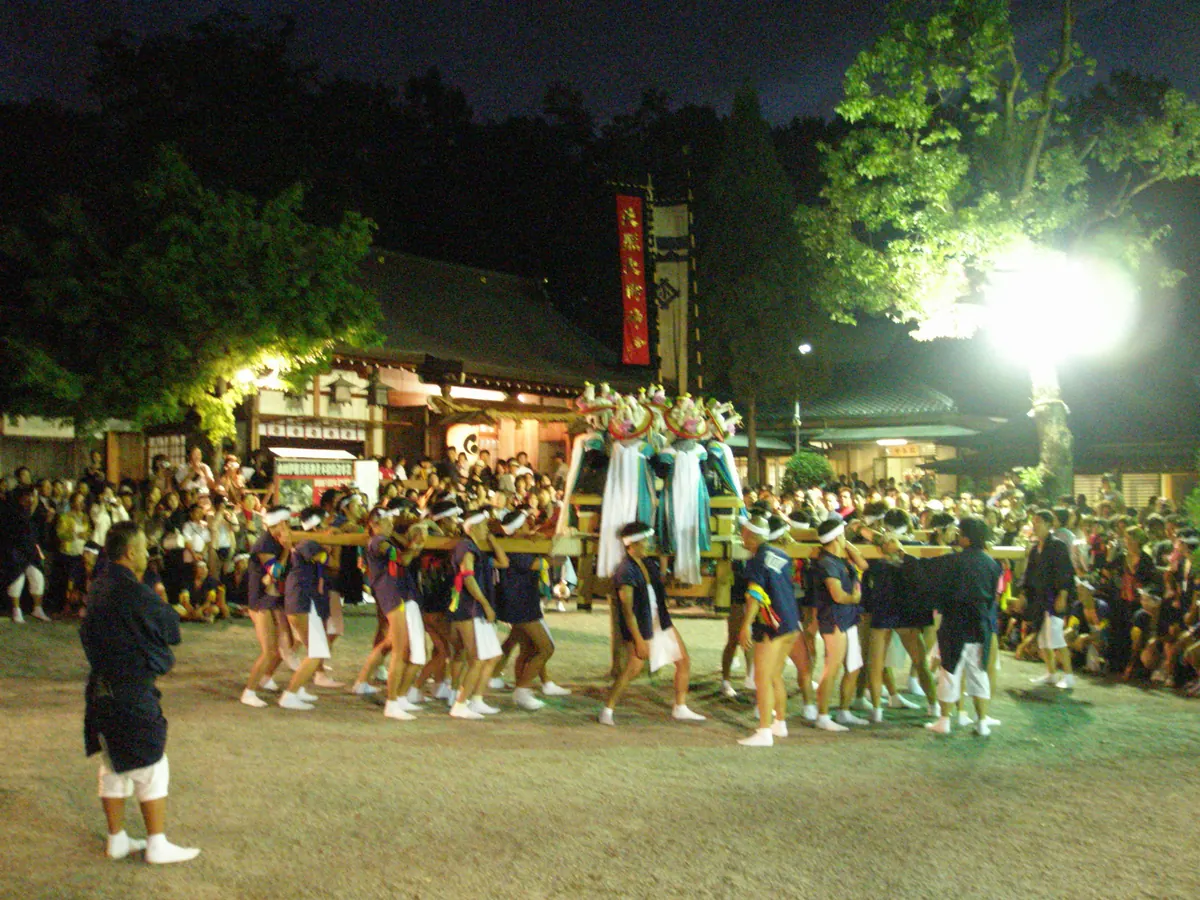
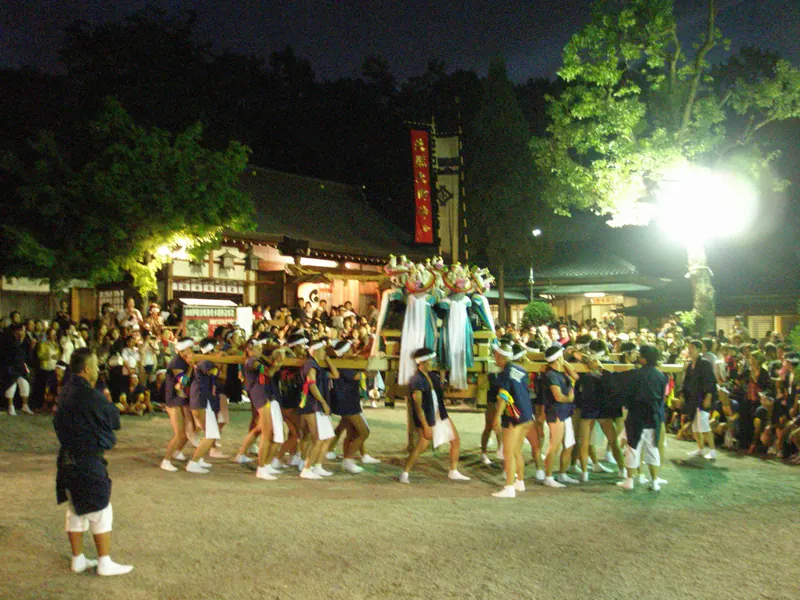
The biggest event is the autumn festival’s taiko mikoshi: a large drum carrying young riders is paraded through the town, and in the grounds it is swung against the sacred tree in a rite called ki-atari (according to the shrine; a Suita City Intangible Cultural Property). Records are too thin to say when it began.
Monthly rite
毎月1日
New Year’s Day rite
1月1日
Ebisu festival
1月9日〜11日
Spring festival
5月10日
Autumn festival · taiko mikoshi parade
10月・スポーツの日の前日 → 2027/10/10
Shichi-go-san (children’s blessing)
11月
Year-end purification
12月31日
Date rules are from the shrine’s official annual-events page. Check the year’s notice for exact dates, start times and the parade route.
Taiko mikoshi at the autumn festival (2006)Karasuma-Oike · CC BY-SA 3.0
04 — HOW TO VISIT
How to pray at a Shinto shrine
1
Bow at the torii
The torii gate marks the sacred area. Give a small bow before passing through, and walk to one side of the path rather than down the middle.
2
Purify at the water basin
If there is a temizuya, rinse your left hand, then right, rinse your mouth with water poured into your left hand, then rinse the ladle handle.
3
Two bows, two claps, one bow
Drop a coin in the offering box, ring the bell if there is one, bow deeply twice, clap twice, make your wish, then bow once more.
4
Photos and quiet
Photography in the grounds is generally fine; avoid shooting inside the halls or during ceremonies. The shrine sits in a residential area, so keep voices low.
05 — ACCESS
Getting there
Address
2-3-1 Yamada-higashi, Suita, Osaka 565-0821
Train + bus
From Yamada or Minami-Senri (Hankyu Senri Line), Yamada (Osaka Monorail), or Momoyamadai / Senri-Chuo (Kita-Osaka Kyuko): Hankyu Bus bound for Suita, Kishibe or JR Ibaraki to “Yamada Miya-no-mae” or “Shin-Ogawa”, right by the stop
Taxi
About 10 minutes from those stations (official site)
Car
Around New Year the area is very congested; public transport is recommended. Check the official site for parking
Phone
06-6877-5921 (9:00–16:30, Japanese)
The official site does not give walking times from the stations; use the 3D map to check the route.
Reference photos taken 2006–2013 (Wikimedia Commons). The entrance torii was rebuilt in 2019, so the gate looks different today.
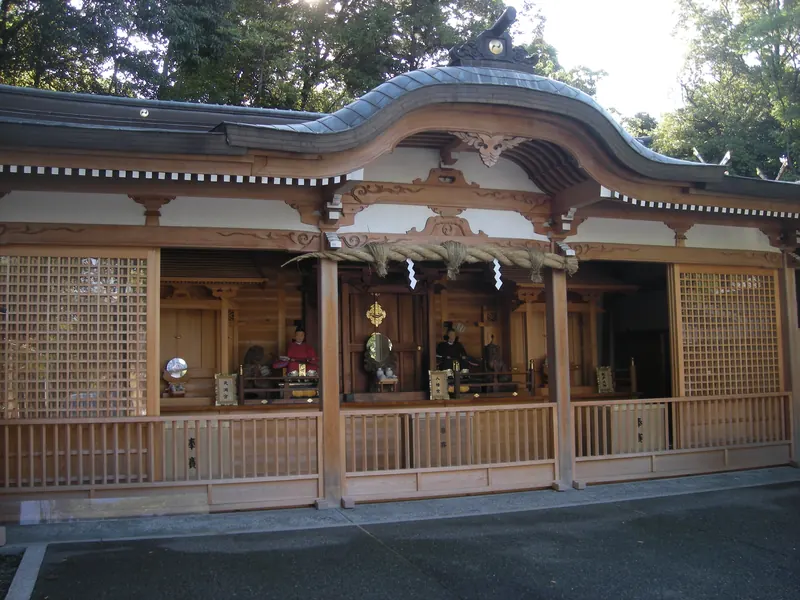
Worship hall (2008)bittercup · CC0Purification hall (2008)bittercup · CC0Maples over the shrine roof (2013)Nankou Oronain · CC BY-SA 3.0Ginkgo on the approach (2013)Nankou Oronain · CC BY-SA 3.0Hachioji sub-shrine (2008)bittercup · CC0Benzaiten sub-shrine (2008)bittercup · CC0Inari sub-shrine (2008)bittercup · CC0The torii before its 2019 rebuild (2013)Nankou Oronain · CC BY-SA 3.0Taiko mikoshi at the autumn festival (2006)Karasuma-Oike · CC BY-SA 3.0
FAQ
FAQ
Which deity is enshrined at Izanagi Shrine?
The principal deity is Izanami-no-Mikoto, the female creator deity of Japanese myth — not Izanagi, despite the shrine’s name. Four other deities share the sanctuary, and the shrine is traditionally visited for marriage, safe childbirth and protection from misfortune.
How do I get to Izanagi Shrine from Osaka?
Take the Hankyu Senri Line to Yamada or Minami-Senri, or the Osaka Monorail to Yamada, then a Hankyu Bus bound for Suita, Kishibe or JR Ibaraki to “Yamada Miya-no-mae” or “Shin-Ogawa”; the shrine is right by the stop. A taxi from those stations takes about 10 minutes. From central Osaka (Umeda) allow about an hour in total.
Is there an entrance fee or opening hours?
The grounds are free to enter and are not gated for visitors. The shrine’s phone desk is open 9:00–16:30 (Japanese). Check the official site for the office hours if you want a goshuin stamp or amulet.
When is the autumn festival?
The shrine’s calendar sets the autumn festival on the day before Sports Day in October (a Sunday). A large drum carrying young riders is paraded through the town and swung against the sacred tree in the grounds. Confirm times and the route in the year’s notice.
Why are there two Izanagi Shrines in Suita?
A second Izanagi Shrine stands in the Saidera district and enshrines Izanagi, while the Yamada shrine enshrines Izanami. The two are often explained together as the “two seats” listed in the Engishiki, though scholars caution against mapping the ancient record directly onto today’s two sites.
How old is Izanagi Shrine?
Tradition links its foundation to the 5th-century Emperor Yūryaku, but that is a legend. The firm records are a court chronicle entry of 859 and the Engishiki register of 927. The present sanctuary building is thought, from its style, to date from the late 17th century.
Can I combine it with Expo ’70 Park?
Yes. The shrine lies about 1.5 km south-west of the Tower of the Sun. Its maples and ginkgo turn colour in late November to early December, the same weeks as the park’s Japanese Garden.
Sources
Checked 22 Oct 2026. The foundation date and the 852 relocation are traditions; the honden date is an estimate from its architectural style. Text written independently from the shrine’s official site, Suita City, the city museum and a published gazetteer.