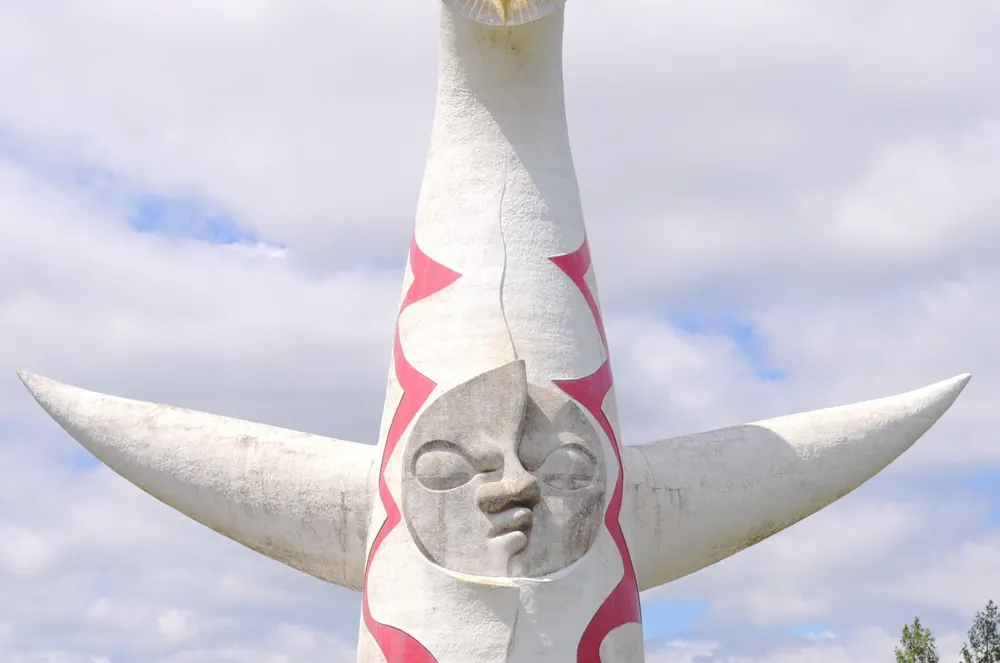
🗺 Open the 3D map of Suita Expo '70 Commemorative Park guide → Book the Tower of the Sun →
Where the name "Suita" comes from
There are several theories, and all of them point to the same thing: this was land blessed with water.
- Sukita theory (the city's official view): records of the monk Gyoki mention a village and canal called Sukita. In cursive script, 吹 looks much like 次, which is how the name came to be written 吹田.
- Founding clan theory: a legend kept by Takahama Shrine says a clan called Sukita no Muraji crossed the Yodo River around the 5th century and founded a village here.
- Wet rice field theories: others connect the name to words for water-logged or marshy fields.
The groundwater of the Senri Hills is still plentiful. That good water gave rise both to Suita's ancient water shrines and, much later, to a beer brewery.
Ancient Suita: the hills that made tiles for the palaces
The oldest traces of people in Suita are stone tools from about 20,000 years ago (the Kishibe site). Farming villages and burial mounds followed.
In the 5th century, the technique for Sue ware — grey, high-fired stoneware — arrived from the Korean Peninsula. Production started in the Senri Hills almost at once, and the area became one of the largest pottery centres in the country, with more than 100 kilns across the hills.
That know-how led to a bigger job: roof tiles for the state's palaces.
| Kiln site | What it made |
|---|---|
| Nanao Tile Kiln Site | Tiles for the Later Naniwa Palace (726–784) of Emperor Shomu — the only known kiln that supplied it National Historic Site (1980) |
| Kishibe Tile Kiln Site | Tiles for the palace of Heian-kyo (today's Kyoto), founded in 794, including green-glazed tiles National Historic Site (1971), now Shikinzan Park |
Tarumi Shrine, dedicated to a god of water and rain, was ranked among the highest class of shrines in the 10th-century Engishiki records. Legend says it was founded in the 7th century by a man who carried the local spring water to the palace in Naniwa through a raised wooden channel. A poem in the Man'yoshu, Japan's oldest poetry anthology, celebrates the "waterfall over the rocks" where bracken sprouts in spring, and it is linked to this spot. A small waterfall still runs in the shrine grounds.
Medieval to Edo: villas, a ferry crossing and a vegetable for the court
- A retreat for the nobility: the poet Fujiwara no Teika visited in 1212 and wrote about it in his diary, and in 1251 the retired Emperor Go-Saga visited the villa Suita-dono.
- Suita Castle: in the Muromachi period a local warrior family, the Suita clan, held a castle here until the clan was destroyed in 1571 by forces under Oda Nobunaga. Its exact location is still unknown.
- The Suita ferry: the Kameoka road between Osaka and Tanba (central Kyoto Prefecture) crossed the Kanzaki River here by boat until a bridge was built in 1875. River traffic on the Yodo and Kanzaki tied Suita closely to the merchant city of Osaka.
- Suita kuwai: a small, sweet variety of arrowhead tuber native to Suita. It is said to have been presented to the Imperial Palace from 1683 until the Meiji Restoration, and its scientific name carries the word suitensis. It is now one of Osaka's certified heritage vegetables.
Two houses of village headmen (shoya) survive. The Former Nishio Family Residence (main house completed in 1895) was designated an Important Cultural Property in 2009, and the Former Nakanishi Family Residence (main house of 1826) is a Registered Tangible Cultural Property. In the late Edo period, many painters and scholars stayed at the Nakanishi house and left their works there.
Meiji and Taisho: beer and railways
- 1876: Suita Station opens with the new government railway.
- November 1889: the Osaka Beer Brewing Company — today's Asahi Breweries — is founded. Suita was chosen for its brewing-quality water and its river and rail links. Local tradition says water from Izudono-gu Shrine was tested in Munich and judged ideal for beer.
- May 1892: Asahi Beer goes on sale from the red-brick Suita brewery. Suita is Asahi's birthplace, and the brewery and the Asahi Beer Museum are still here.
- 1922: Kansai University moves to Senriyama. The Senriyama housing estate, begun in 1920 with streets radiating from a fountain, was a planned garden suburb that foreshadowed Japan's later new towns.
- 1923: the Suita marshalling yard opens. At its peak it handled about 8,000 freight wagons a day and was called the largest yard in the East, and Suita became known as "the town of beer and railway yards".
A new city, and Japan's first large new town
Suita was the seventh city in Osaka Prefecture, and it reached roughly its present size by 1955.
Senri New Town, developed by Osaka Prefecture, welcomed its first residents in Satakedai in September 1962. It covers 1,160 hectares across Suita and Toyonaka with a planned population of 150,000. Each neighbourhood was given its own primary school and local shopping centre, and pedestrians were kept apart from cars — a model that shaped Japanese town planning for decades. Hankyu's Kita-Senri Station, opened in 1967, was the first station in Japan with automatic ticket gates.
The 1970 World's Fair was held right next door. The Senri New Town information centre calls the two "twin cities of the future": the Expo showed a distant future, while the new town was a future people could actually live in.
1970: Asia's first World's Fair
| Dates | 15 March – 13 September 1970 (183 days) |
|---|---|
| Site | Senri Hills, Suita (330 ha) |
| Theme | Progress and Harmony for Mankind |
| Participants | 76 countries, 4 international organisations and others (77 countries including Japan) |
| Visitors | 64,218,770 — a World's Fair record at the time |
The US Pavilion showed a Moon rock brought back by Apollo 12. Visitors also met a "wireless telephone" (an early mobile phone), video phones and moving walkways, and canned coffee, family restaurants and Kentucky Fried Chicken also became widely known in Japan through the fair.
Railways and roads built for the Expo — the Kita-Osaka Kyuko line, the Chugoku Expressway and the Shin-Midosuji road — still form the backbone of Suita's transport today. At the centre of the site stood architect Kenzo Tange's giant Grand Roof, and bursting up through it was the Tower of the Sun.
The Tower of the Sun: Taro Okamoto's legacy
Taro Okamoto (1911–1996) deliberately placed a primal, powerful tower at the heart of an Expo celebrating progress. The story goes that when he saw the model of the Grand Roof, he decided to cut a hole in it and let his tower break through.
| Face | Where | Meaning |
|---|---|---|
| Golden Face | At the top | The future |
| Face of the Sun | On the front | The present |
| Black Sun | On the back | The past |
| Sun of the Underworld | In the underground exhibit of 1970 | Lost after the fair; recreated in 2018 |
Inside stands the Tree of Life, about 41 m tall, tracing evolution from single-celled organisms through dinosaurs to humans.
- 1975: after a petition campaign, the decision is made to preserve the tower permanently
- March 2018: after earthquake-proofing, the interior opens to the public again for the first time in 48 years (booking required)
- 2020: registered as a Tangible Cultural Property
- 27 August 2025: designated a National Important Cultural Property (structure), praised for realising a huge, unique form with the most advanced technology of its day
The original Golden Face is on display in the EXPO'70 Pavilion annex inside the park. For interior tickets and booking, see Tower of the Sun tickets.
After the Expo: a park, museums, a stadium and a health city
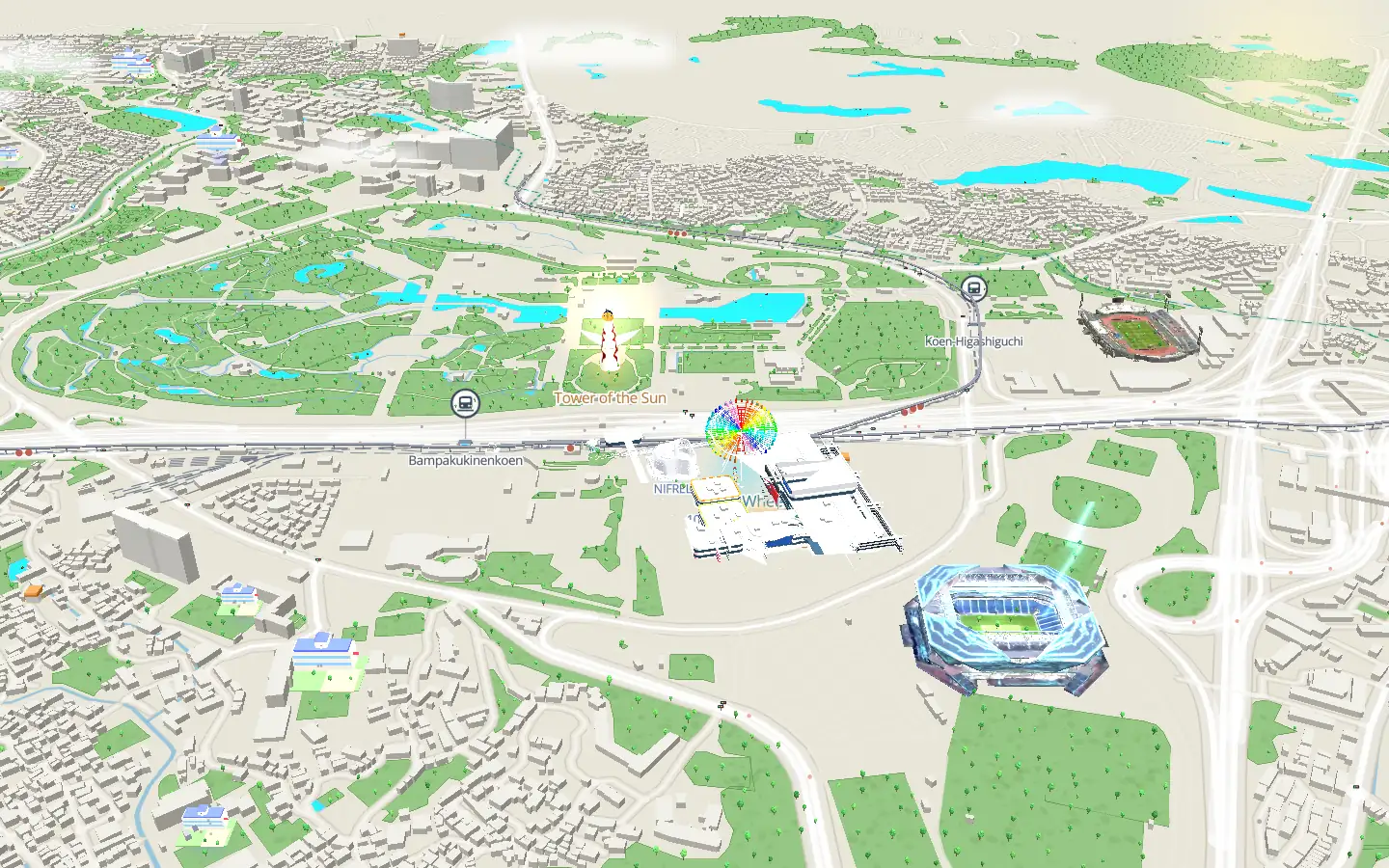
- 1972: Expo '70 Commemorative Park opens (about 264 ha). The site was replanted and grown back into a forest. The Japanese Garden and the Japan Folk Crafts Museum, Osaka are also legacies of the fair.
- 1977: the National Museum of Ethnology (Minpaku) opens, one of Japan's leading museums, with everyday objects from around the world.
- 1992: Suita City Museum opens, showing finds from the ancient kilns and burial mounds.
- 1993: Gamba Osaka plays in the first J.League season. In 2015 Japan's first football stadium funded by public and corporate donations (now Panasonic Stadium Suita) is completed.
- 2015: EXPOCITY opens on the site of the old Expoland amusement park. Its Osaka Wheel, opened in 2016 and 123 m tall, is the tallest Ferris wheel in Japan.
- 2018–2023: the former Suita marshalling yard becomes Kento, home to the National Cerebral and Cardiovascular Center and other institutions.
- 2020: Suita becomes a core city and marks 80 years as a city.
- 2025–2026: after Expo 2025 Osaka, Kansai closes, statues of its mascot Myaku-Myaku are moved to stand in front of the Tower of the Sun.
Timeline
| Year | Event |
|---|---|
| c. 20,000 years ago | Stone tools used at the Kishibe site — the oldest human traces in Suita |
| 5th century | Sue ware production begins on the Senri Hills |
| 7th century | Spring water is sent to the Naniwa palace and Tarumi Shrine is said to be founded |
| 726–784 | Nanao kilns make tiles for Naniwa Palace |
| 794 onwards | Kishibe kilns make tiles for the palace of Heian-kyo (Kyoto) |
| 1251 | Retired Emperor Go-Saga visits the villa Suita-dono |
| 1571 | The Suita clan of Suita Castle falls |
| 1683 onwards | Suita kuwai is said to be presented to the Imperial Palace |
| 1826 | Main house of the Nakanishi residence built |
| 1875 | A bridge replaces the Suita ferry |
| 1876 | Suita Station opens |
| 1889 | Osaka Beer Brewing Company (today's Asahi) founded |
| 1892 | Asahi Beer goes on sale |
| 1922 | Kansai University moves to Senriyama |
| 1923 | Suita marshalling yard opens |
| 1940 | Four towns and villages merge to form Suita City |
| 1962 | First residents move into Senri New Town |
| 1970 | Expo '70 (64.2 million visitors) |
| 1972 | Expo '70 Commemorative Park opens |
| 1975 | Permanent preservation of the Tower of the Sun decided |
| 1977 | National Museum of Ethnology opens |
| 1990 | Osaka Monorail opens |
| 1992 | Suita City Museum opens |
| 2009 | Nishio residence designated an Important Cultural Property |
| 2015 | Suita City Football Stadium and EXPOCITY completed |
| 2018 | Tower of the Sun interior reopens after 48 years |
| 2020 | Suita becomes a core city; 80th anniversary |
| 2025 | Tower of the Sun designated an Important Cultural Property |
Where to see Suita's history today
| Place | What you can see | Nearest station |
|---|---|---|
| Tower of the Sun / Expo '70 Commemorative Park | The tower's interior (booking required), the original Golden Face, relics of the fair | Banpaku-kinen-koen (Osaka Monorail) |
| National Museum of Ethnology | Everyday objects from around the world (inside the park) | Banpaku-kinen-koen (Osaka Monorail) |
| Suita City Museum / Shikinzan Park | Kishibe Tile Kiln Site (National Historic Site), finds from burial mounds, Expo material | JR Kishibe |
| Former Nishio Family Residence | A headman's house and garden, an Important Cultural Property | JR Suita |
| Former Nakanishi Family Residence | A late-Edo headman's house (free admission) | JR Kishibe |
| Tarumi Shrine | The spring water and small waterfall of the Man'yoshu poem | Hankyu Toyotsu |
| Asahi Beer Museum | Brewery tour and tasting at Asahi's birthplace | JR Suita |
Opening days, fees and booking rules differ by site and can change. Please check each official website before you go. For station locations, see Suita stations and buses.
Common mix-ups
- The 1970 and 2025 Expos were in different places: 1970 on the Senri Hills in Suita, 2025 on Yumeshima in Osaka City, about an hour apart by train.
- Senri-Chuo Station is not in Suita: it is a common transfer point for the park, but it is in Toyonaka.
- Asahi's story starts in 1889: the company was founded in 1889, the Suita brewery was completed in 1891 and the beer went on sale in 1892.
- The Tower of the Sun is an Important Cultural Property: it was registered as a cultural property in 2020 and raised to Important Cultural Property in 2025.
- Shikinzan Kofun is in Ibaraki: it is a different place from Shikinzan Park, where the Suita City Museum stands.
Suita history FAQ
When did Suita become a city?
On 1 April 1940, when Suita Town, Senri Village, Kishibe Village and Toyotsu Village merged. It was the seventh city in Osaka Prefecture.
How do you pronounce Suita, and what does the name mean?
It is pronounced "SOO-ee-tah". The city's official view is that it comes from Sukita, an 8th-century place name, whose sound shifted to Suita and came to be written with the similar-looking character 吹. Other theories link it to wet rice fields.
Where was the 1970 Osaka Expo held?
On the Senri Hills in Suita. The site is now Expo '70 Commemorative Park, where the Tower of the Sun still stands. It is a different place from Expo 2025 Osaka, Kansai, which was held on Yumeshima in Osaka City.
How many people visited Expo '70?
64,218,770 people — a World's Fair record at the time. It ran for 183 days, from 15 March to 13 September 1970.
Who made the Tower of the Sun?
The artist Taro Okamoto. It was built as the Theme Pavilion of Expo '70 and is about 70 m tall.
Is the Tower of the Sun a cultural property?
Yes. It was designated a National Important Cultural Property (structure) on 27 August 2025, after being registered as a Tangible Cultural Property in 2020.
Can you go inside the Tower of the Sun?
Yes. The interior has been open since 2018 and requires advance booking. Inside you can see the Tree of Life, which traces the story of evolution. See Tower of the Sun tickets for prices and booking.
Was Asahi Beer born in Suita?
Yes. The Osaka Beer Brewing Company (today's Asahi Breweries), founded in 1889, built its brewery in Suita and launched Asahi Beer in 1892. Suita was chosen for its good brewing water and transport links. The Asahi Suita Brewery and its museum are still here.
What is Senri New Town?
Japan's first large-scale planned new town, which welcomed its first residents in 1962. It covers 1,160 hectares across Suita and Toyonaka for a planned 150,000 people and became a model for Japanese town planning.
What is the oldest historic site in Suita?
Among National Historic Sites, the Nanao Tile Kiln Site (8th century, tiles for Naniwa Palace) and the Kishibe Tile Kiln Site (from 794, tiles for the palace of Heian-kyo). The oldest human traces are stone tools about 20,000 years old from the Kishibe site.
Where can I learn about Suita's history?
Suita City Museum, a walk from JR Kishibe Station, covers the whole story from ancient times. For Expo '70, visit the EXPO'70 Pavilion inside the park, the interior of the Tower of the Sun and the National Museum of Ethnology.
Official sources: Suita City: city history · Suita City: ancient to early modern · Suita City: modern era · Cultural Heritage Online: Nanao Tile Kiln Site · Expo '70 Commemorative Park: Important Cultural Property · Asahi Breweries: when Asahi began · Tarumi Shrine