
A spring that answered a prayer
Shrine tradition says that in a great drought in 869 people welcomed Susanoo's sacred palanquin and prayed for rain — and clear water welled up. 'Izudono' means 'spring hall'.
SUITA SHRINES · IZUDONO-GU SHRINE
A station-side shrine linking a rain-prayer spring with the birth of Suita's beer — the story of a spring that no longer flows.
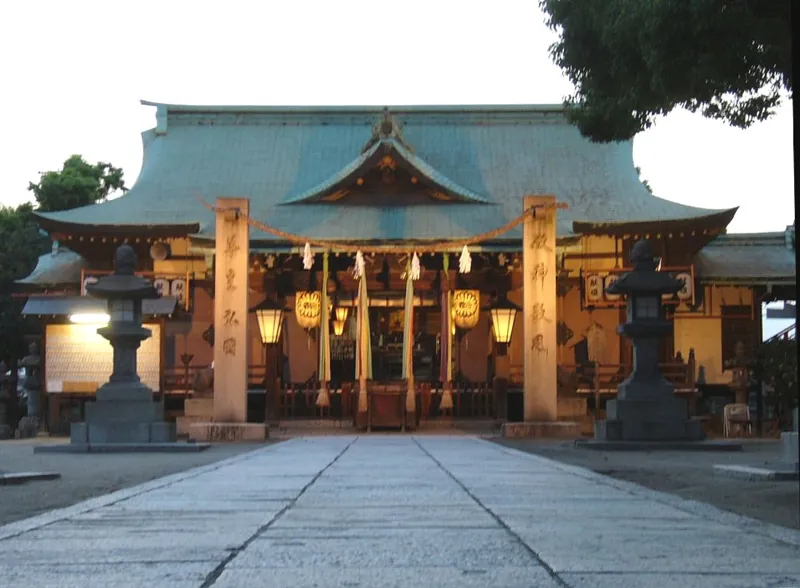
The worship hall · Photo 2006 · Bakkai (CC BY-SA 3.0)
Izudono-gu is a Shinto shrine about 2 minutes on foot from Hankyu Suita Station. Tradition says a spring welled up here during a rain prayer in 869. In 1889 its water was judged ideal for brewing in Munich, leading to Osaka Beer's (now Asahi) Suita brewery. The spring stopped flowing in the late 1950s.
01 — HIGHLIGHTS
A station-side shrine linking a rain-prayer spring with the birth of Suita's beer.
Shrine tradition says that in a great drought in 869 people welcomed Susanoo's sacred palanquin and prayed for rain — and clear water welled up. 'Izudono' means 'spring hall'.
In 1889 the spring water was judged ideal for brewing in Munich, and Osaka Beer (today's Asahi) opened its Suita brewery nearby. Suita's beer story starts here.
A rare kagura lion dance where one lion stands on top of another — a registered intangible folk cultural property of the city.
Just off Hankyu Suita Station, with the Toka Ebisu fair in January and a water festival in August.
02 — HISTORY
Tradition (legend), written records and expert estimates are labelled separately.
Tradition says clear water welled up when people prayed for rain with Susanoo's palanquin.
The shrine priest Miyawaki Shima is recorded as joining his teacher Oshio Heihachiro's revolt.
The spring water was rated excellent for brewing beer.
Osaka Beer opened a brewery nearby — the origin of today's Asahi Suita plant.
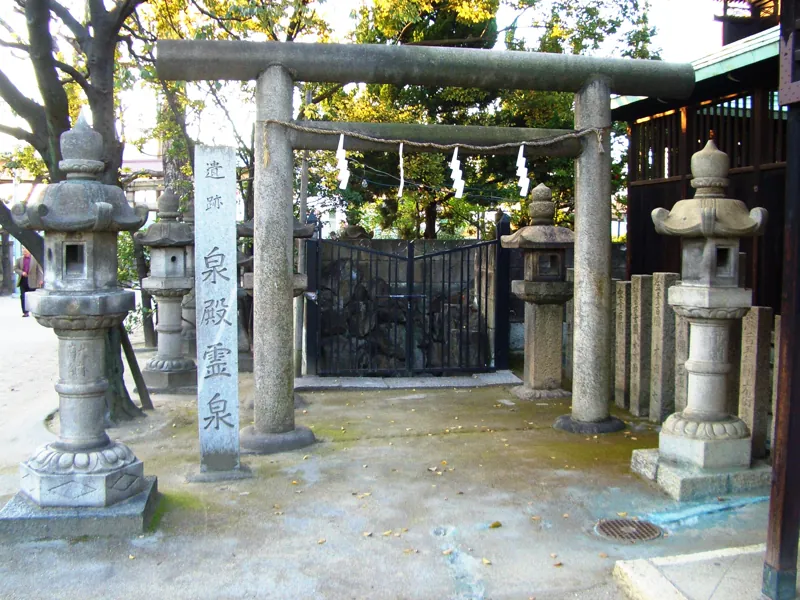
With development around it the spring dried up; its remains are preserved.
03 — FESTIVALS
| Toka Ebisu | Jan 9–11 |
|---|---|
| Kinensai (prayer for harvest) | Apr 3 |
| Annual festival | May 3 |
| Summer purification | Jun 30 |
| Water festival | Aug 3 |
| Niinamesai | Oct 3 |
Dates follow the shrine's published calendar. Check each year's notice for times and details.
04 — HOW TO VISIT
The torii gate marks the sacred area. Give a small bow before passing through, and walk to one side of the path rather than down the middle.
If there is a temizuya, rinse your left hand, then right, rinse your mouth with water poured into your left hand, then rinse the ladle handle.
Drop a coin in the offering box, ring the bell if there is one, bow deeply twice, clap twice, make your wish, then bow once more.
Photography in the grounds is generally fine; avoid shooting inside the halls or during ceremonies. The shrine sits in a residential area, so keep voices low.
05 — ACCESS
| Address | 10-1 Nishinosho-cho, Suita |
|---|---|
| Phone | 06-6388-5680 |
| Official site | www.idudono.jp ↗ |
About 2 min on foot from Hankyu Senri Line Suita Station (Osaka Jinja-cho). JR Suita Station is also within walking distance.
06 — PHOTOS
Free-licensed photos from Wikimedia Commons, shown with the year taken. Older photos may differ from today.
FAQ
No. It stopped in the late 1950s; the remains are preserved.
In 1889 the spring water was rated ideal for brewing, and Osaka Beer (today's Asahi) opened its Suita brewery nearby.
About 2 minutes on foot from Hankyu Senri Line Suita Station (Osaka Jinja-cho).
Written independently from the shrine's official site, Suita City and the Osaka Jinja-cho.
Checked: 2026-10-25